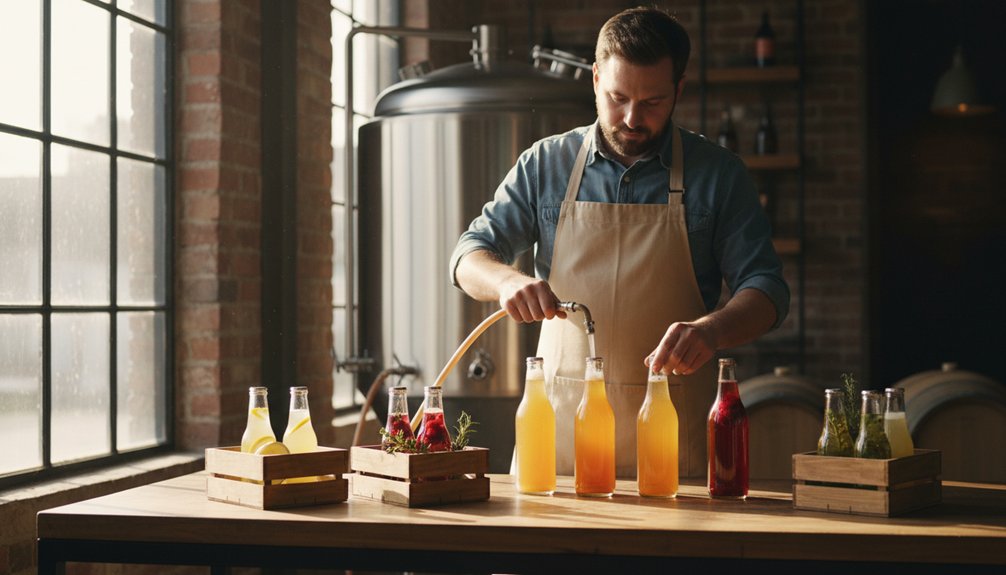
You can turn small-batch craft beverage production into market impact by validating demand before scaling. Choose a clear customer and occasion, then set pilot targets for yield, quality, cost, and sustainability. Source distinctive ingredients, document recipes, and monitor pH, temperature, and flavor to keep batches consistent. Use flexible equipment that fits demand, and test limited runs through pop-ups, retailers, and online orders. Track repeat sales and margins to refine pricing, positioning, and production; smart growth starts with measured decisions.
Key Takeaways
- Validate a distinctive beverage concept through customer interviews, competitor research, and limited sales before committing to large-scale production.
- Design pilot batches with measurable targets for yield, production time, quality consistency, customer feedback, and sustainability.
- Source traceable ingredients and standardize recipes, processing conditions, and quality checks to preserve flavor as batches scale.
- Match modular equipment and production capacity to realistic demand, seasonal peaks, utilities, and packaging needs.
- Track conversion, repeat purchases, and unit economics; refine pricing, positioning, and distribution based on results.
Choose Your Beverage and Target Customer

Before investing in equipment or ingredients, decide what you’ll make and who’ll buy it. Choose a beverage concept that fits your capabilities and solves a clear customer need. You might develop a botanical soda, fermented tea, or low-alcohol aperitif, but anchor the idea in a distinct use occasion and credible point of difference.
Use Customer segmentation to define buyers by preferences, lifestyle, purchasing habits, and willingness to pay. Interview potential customers and review retail trends; don’t rely on assumptions about what “everyone” wants.
Then shape Flavor innovation around the audience: test ingredients, sweetness, acidity, aroma, and texture to create a recognizable profile. Check that your concept aligns with relevant labeling rules and category expectations.
A focused product story helps retailers understand its shelf role and gives customers a reason to choose it over familiar alternatives.
Set Small-Batch Production Goals
Once your beverage concept and target customer are clear, set small-batch goals that test both the recipe and its market fit.
Define a pilot volume that your equipment can produce consistently, then assign measurable targets for yield, batch time, unit cost, and quality variation.
Set a sampling schedule and gather feedback from customers who match your intended audience; track purchase intent alongside taste ratings.
Use the run to test Packaging innovation, such as formats that improve shelf presence or simplify serving, without committing to large orders.
Build Sustainability practices into your metrics by monitoring water, energy, and packaging waste per unit.
Establish thresholds for scaling, revising, or stopping production before the trial begins.
Your goals should turn each batch into actionable evidence, not merely a smaller version of full-scale manufacturing.
Pick Ingredients That Make Your Beverage Stand Out
Choose distinctive, traceable ingredients that give your beverage a clear point of difference and a compelling story.
Then balance sweetness, acidity, bitterness, and aroma with precise formulation and repeatable trials.
You’ll create a signature profile customers recognize—and competitors can’t easily replicate.
Source Distinctive Ingredients
Distinctive ingredients give your beverage a signature flavor and a clear place in the market. To source them, look beyond commodity catalogs: build relationships with regional growers, specialty importers, and small-scale processors who can offer traceable, consistent lots. Ask about harvest windows, post-harvest handling, minimum orders, and supply variability before you commit.
Request samples and technical specifications, then test ingredients in pilot batches to measure extraction, color, aroma, and production performance.
Herbal infusions, unusual fruits, and responsibly sourced botanicals can support unique flavor combinations that competitors can’t easily replicate. Verify food safety documentation, allergen controls, and applicable labeling requirements; distinctive sourcing still needs dependable compliance.
Compare landed cost, yield, and shelf-life impact, not just price per kilogram. Secure backup suppliers for high-risk materials, and document approved substitutions. Strong sourcing turns a compelling concept into a scalable, market-ready product.
Balance Flavor Profiles
A standout beverage depends on more than a novel ingredient; it needs a flavor profile in which sweetness, acidity, bitterness, aroma, and texture work together. You can shape that balance by testing ingredients in measured increments, then adjusting one variable at a time.
A bright citrus note may lift a rich malt base, while herbs or roasted botanicals can add depth without overwhelming it. Use Flavor pairing to connect familiar tastes with a distinctive signature, and evaluate each blend at serving temperature.
Profile balancing also means accounting for carbonation, dilution, and finish; these factors can sharpen acidity or mute aroma. Gather structured feedback from target customers, not just your production team.
When you refine for both sensory harmony and clear differentiation, you’ll create a beverage that earns repeat purchases and stands out on crowded shelves.
Scale Recipes for Consistent Batches
When you scale a craft beverage recipe, treat every ingredient as a process variable—not just a larger quantity to multiply. Preserve the sensory signature by converting measurements to weight, then scaling each component against total batch volume.
Ingredient pairing can shift at higher concentrations, so validate extracts, acids, sweeteners, and botanicals in pilot batches before committing production inputs. Track pH, gravity, temperature, and contact time; small deviations can reshape aroma, stability, and perceived sweetness.
Use controlled trials to refine flavor balancing, then document the winning formula with tolerances and mixing order. Don’t assume a linear increase will deliver the same result: extraction, dilution, and ingredient variability can alter outcomes.
Compare samples against a retained reference, and adjust one variable at a time. Consistent batches protect customer trust while helping you forecast costs, yields, and margins.
Choose Equipment for Your Production Needs
Choose equipment that matches your batch capacity, so you can meet demand without tying up capital in excess throughput.
Prioritize versatile, reconfigurable systems that adapt as recipes and market opportunities shift.
Plan for growth with modular capacity and utilities that can scale without disrupting production.
Match Equipment to Capacity
How much capacity should your equipment handle? Size your system around realistic demand, not your most optimistic forecast. Estimate weekly volume, batch frequency, seasonal peaks, and the time each product spends in tanks, then map those figures to brewhouse, fermentation, and packaging throughput.
Capacity planning helps you spot bottlenecks before they constrain launches or delay orders. You’ll also protect cash flow by avoiding oversized equipment that sits idle and ties up capital.
Build in enough headroom for measured growth, but compare capacity against your current sales channels and production schedule. Check utilities, floor space, and labor requirements alongside rated output; a machine’s advertised capacity won’t guarantee practical throughput.
Factor Equipment maintenance into your operating model, since downtime can reduce usable capacity. Choose equipment that meets today’s targets and supports a credible path to profitable scale.
Prioritize Versatility and Flexibility
Versatile equipment lets you adapt production without buying a separate machine for every product or process. Choose tanks with adjustable agitation, temperature control, and interchangeable fittings so you can shift between ales, seltzers, and seasonal releases with minimal downtime.
For Flavor experimentation, prioritize systems that support precise dosing, small test batches, and repeatable recipes; you’ll refine profiles without tying up your main line.
Flexible fillers and labelers enable Packaging diversity, helping you serve cans, bottles, or limited-run formats as customer preferences change. Check changeover time, sanitation requirements, and compatibility with your ingredients before you commit.
A modular setup can protect product quality while keeping labor and cleaning costs manageable. Match each option to your current production needs, then compare its performance across the products you actually plan to make.
Plan for Future Growth
As demand grows, size your equipment for the production milestones you can realistically forecast—not just today’s output. Map expected volume by product, season, and channel, then match tank capacity, packaging speed, and utilities to those targets.
Modular systems let you add fermenters or automate filling without rebuilding your line. Choose equipment with documented sanitation controls and traceability features to meet industry regulations as your operation scales.
Before committing, model labor, energy, maintenance, and financing costs; a larger vessel isn’t always the smarter investment.
Align capacity with your marketing strategies, too. A retail launch, taproom expansion, or contract-brewing partnership can each reshape demand and packaging needs.
Ask vendors about changeover times, upgrade paths, spare parts, and service response. Pilot new formats on flexible equipment, track throughput and waste, and expand only when sales data supports the next step.
Keep Your Beverage Safe and Fresh
Freshness starts with control: protect your beverage from contamination and spoilage at every production stage. Build Fermentation safety into your process with validated cleaning routines, calibrated sensors, and documented checks for temperature, pH, and pressure. These controls help you catch deviations before they compromise flavor or consumer trust.
Then design Packaging freshness into every run. Choose containers and closures that suit your beverage’s acidity, carbonation, and light sensitivity. Sanitize filling equipment, minimize oxygen pickup, and verify seals to protect shelf life without overengineering your line. Track lot codes and retain samples so you can trace issues quickly and refine your controls.
Your production records aren’t paperwork for its own sake; they’re a quality system that supports consistent releases, retailer confidence, and responsible growth. Set clear hold-and-release criteria, and train every operator to act on them.
Test Limited Runs With Customers
Launch a limited run to gauge early demand before committing production capacity.
Track sell-through and invite customers to share structured tasting feedback.
Use those signals to refine the formula and positioning before you scale.
Gauge Early Interest
Before committing to a full production run, test a limited batch with target customers. Treat this pilot as a demand experiment, not a tasting session.
Use Market research and competitor analysis to define a clear hypothesis: which audience will buy, at what price, and through which channel?
Offer a small, trackable quantity through a pop-up, preorder page, or select retail partner.
Measure conversion rates, sell-through speed, repeat purchases, and waitlist sign-ups; these signals reveal intent more reliably than casual praise.
Segment results by customer type and acquisition source, then compare performance against your launch targets.
If demand exceeds supply, model capacity and margin before scaling.
If uptake lags, adjust positioning, pack size, price, or distribution and run another controlled test.
Let evidence—not enthusiasm—set your next production threshold.
Gather Tasting Insights
A pilot batch can validate not just demand, but whether the beverage delivers the flavor and experience customers expect. Invite target customers to taste a limited run in realistic settings, then capture reactions immediately through structured surveys and guided conversations.
Ask them to rate aroma, sweetness, acidity, mouthfeel, finish, and purchase intent; open-ended prompts can reveal unexpected associations or objections. Compare responses across audience segments to see which flavor combinations create distinction without sacrificing approachability.
Track ingredient sourcing details alongside each sample, so you can connect preferences to specific botanicals, fruits, or production choices. Use blind tasting where practical to reduce brand bias, then reveal the concept and price to test perceived value.
Treat every comment as evidence, not a verdict, and document patterns that clarify your product’s strongest market promise.
Refine Before Scaling
Use tasting feedback to refine the recipe in small, controlled runs before committing to scale. Adjust one variable at a time—acidity, sweetness, carbonation, or infusion—so you can link customer reactions to specific changes.
Track batch data alongside structured ratings and purchase intent; repeat tests with target segments to distinguish durable preferences from novelty effects. Set clear thresholds for flavor acceptance, production consistency, and margin before expanding output.
Test shelf life and serving performance under realistic conditions, not just at the tasting table. Use Marketing collaborations with local chefs, retailers, or creators to recruit relevant tasters and gauge demand.
Pair limited releases with Packaging innovations that improve usability, communicate provenance, or protect freshness. When results meet your benchmarks, lock the formula and process, then scale in stages while monitoring quality and sell-through.
Price Your Beverage for Profit and Repeat Sales
Pricing your beverage well means balancing ingredient, packaging, labor, and distribution costs against what customers will pay—and what retailers and distributors need to earn.
Build a unit-economics model that captures every cost, including spoilage, freight, promotions, and payment fees. Then set wholesale and direct-to-consumer prices that protect profit margins across channels, rather than relying on a single markup.
Stress-test your model against ingredient volatility and different production volumes so growth doesn’t quietly erase earnings.
Use Pricing psychology to make your price feel deliberate: test tiered sizes, bundles, and price points near familiar thresholds. Compare competitor prices, but don’t anchor your value to the cheapest option.
Track conversion, repeat purchase, and contribution margin by channel; adjust when data shows friction. Your goal isn’t simply a premium shelf tag—it’s a sustainable price customers accept and retailers can reorder profitably.
Tell a Clear Story About Your Brand
When customers face a crowded cooler, a clear brand story gives them a reason to choose—and remember—your beverage. Define the specific idea behind your recipe: a regional ingredient, a fermentation method, or a flavor pairing with a point of view.
Then connect that choice to a customer benefit, such as distinctive aroma, lower sweetness, or a sense of place. Strong Brand storytelling turns production decisions into memorable signals; it doesn’t rely on vague claims about quality or tradition.
Keep your language consistent across the label, product name, and tasting notes, and make every detail verifiable. This focus sharpens Market differentiation without adding complexity to your process.
Test your core message with target drinkers: if they can repeat what makes your beverage distinct after one glance, your story is doing its job.
Sell Through Local Retailers, Events, and Online Orders
Where will your beverage earn its first repeat buyers? Start with nearby retailers whose shoppers match your target profile. Pitch a focused assortment, clear margins, reliable case quantities, and a concise sell sheet that turns your brand story into a shelf-ready reason to buy. Track reorder velocity, not just initial placements.
Use tastings, farmers’ markets, and pop-up events to collect direct feedback and convert trial into loyalty. Capture opt-in contacts, then test limited releases against customer response.
Build distribution partnerships with retailers, venues, and local delivery services that can extend reach without straining small-batch capacity.
Treat online orders as another data-rich route to market. Offer compliant shipping or pickup, bundle complementary products, and streamline checkout. Compare conversion, repeat rate, and fulfillment costs across marketing channels; shift inventory toward the combinations that deliver sustainable contribution margins.
Conclusion
A successful craft beverage starts with a clear customer, a distinctive recipe, and a batch size you can control. Track every ingredient, standardize each process, and let customer feedback sharpen the next run. Then price for healthy margins and build a brand story that travels from tasting table to retail shelf and online cart. Treat each small batch as a market signal: refine what resonates, scale what sells, and keep your production nimble as demand grows.