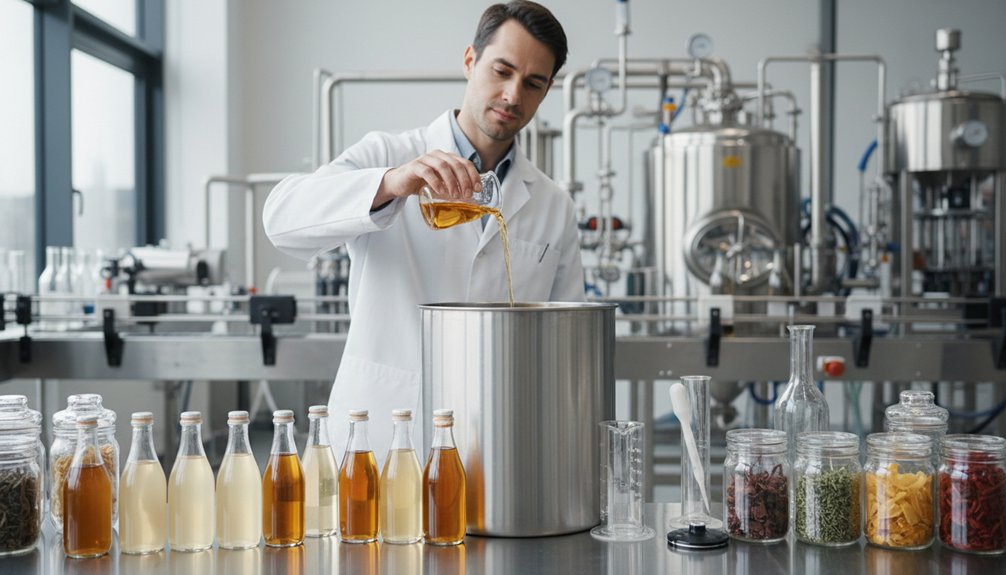
To scale a new drink formula from benchtop to bottle, first define your batch targets, process limits, and measurable acceptance criteria. Lock the formula and specifications once pilot results meet those criteria, then qualify suppliers and control ingredient substitutions. Increase batch size in measured steps, validating process conditions, equipment, packaging, and product safety at each stage. Monitor sensory and laboratory results throughout production, and track yield and costs without compromising flavor. The steps below help you manage each decision consistently.
Key Takeaways
- Define batch targets, product specifications, equipment limits, acceptance criteria, and responsibilities before scaling.
- Increase batch size incrementally, measuring pH, solids, acidity, sensory qualities, yield, and processing performance at each stage.
- Qualify suppliers and control ingredient substitutions, since small changes can alter flavor, texture, color, and production behavior.
- Validate processing and packaging through pilot runs, checking equipment performance, product safety, stability, and distribution suitability.
- Lock the formula and specifications only after trials meet defined criteria; document changes, verify quality, and support date codes with stability evidence.
Plan Your Beverage Scale-Up
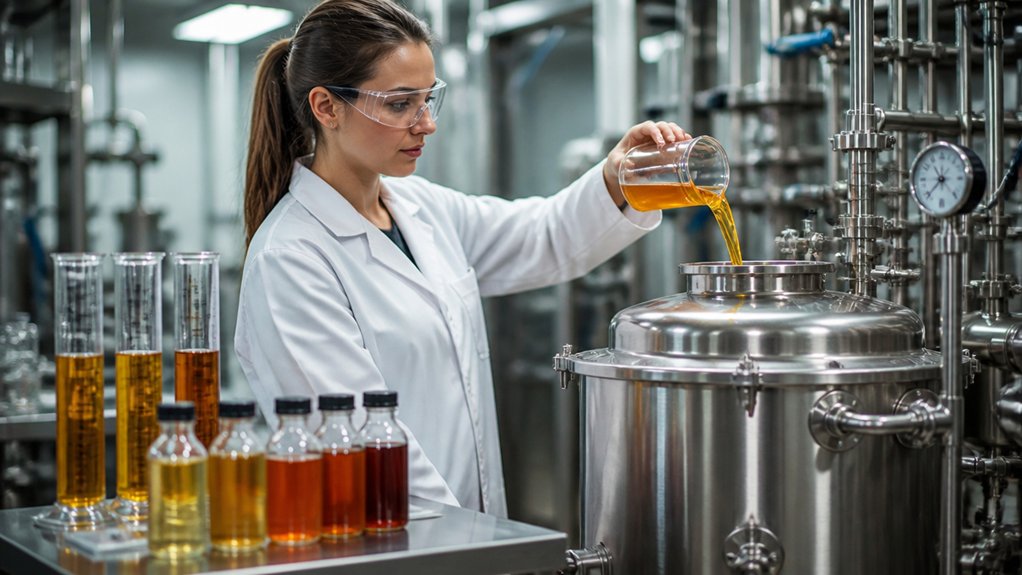
Before increasing production, define the target batch size, process limits, and product specifications. Then map each scale-up stage, from pilot runs to commercial output, against available equipment, labor, and schedule.
Identify capacity constraints early: mixing power, heating and cooling rates, fill speed, and packaging availability can all affect throughput.
Set measurable acceptance criteria for each trial, including yield, processing time, and sensory performance.
Assign owners to monitor risks, record deviations, and approve decisions; don’t rely on informal handoffs.
If you’re testing Flavor enhancement, plan controlled trials that fit your production window and budget.
Protect branding consistency by checking how larger batches and production conditions affect the customer experience.
Build contingency time into the plan, and use pilot results to guide the next production step without committing resources prematurely.
Lock Down Your Formula and Specs
Once pilot results meet your acceptance criteria, lock the formula and document every specification needed to reproduce it. Record each ingredient’s exact percentage, addition order, processing conditions, and target batch yield.
Define measurable limits for pH, soluble solids, acidity, color, viscosity, carbonation, and fill volume, as relevant to your drink. Specify test methods, sampling points, instruments, and acceptable tolerances so operators can verify results consistently.
Include packaging details and storage conditions because they can affect product performance. Set a controlled change process: assign revision numbers, identify approvers, and require trials before adopting substitutions or process adjustments.
Preserve Formulation flexibility by distinguishing critical attributes from adjustable parameters, but don’t leave either undefined. Document Ingredient sourcing requirements as specifications—not purchasing instructions—to keep the formula reproducible without dictating the next production step.
Source Ingredients for Consistent Production
With the formula and specifications locked, qualify suppliers against the ingredient attributes that affect product consistency, such as identity, composition, functional performance, and lot-to-lot variability.
Request current specifications, certificates of analysis, allergen statements, and change-control policies.
Define acceptance limits for critical measures, including active content, moisture, particle size, and microbiological criteria, where relevant.
Confirm that each supplier can provide traceable lots and notify you before changing a source, process, or specification.
For ingredient sourcing, assess availability, lead times, minimum order quantities, and storage requirements alongside price.
Test representative samples against your approved benchmarks before purchase, and document the results.
Strong supplier relationships help you resolve deviations quickly and maintain reliable access to qualified materials.
Assign approved sources to each ingredient, keep backup suppliers where feasible, and review performance using delivery, documentation, and quality records.
Don’t substitute materials without formal review and approval.
Scale Up Your Beverage Formula
After qualifying your ingredient sources, scale the beverage formula through controlled, measured steps rather than multiplying every quantity at once. Increase batch size in stages, recording each ingredient’s weight, addition order, and mixing time.
At every stage, measure pH, soluble solids, acidity, color, and sensory attributes against your bench sample. Larger volumes can change dissolution, dispersion, and flavor balance, so adjust one variable at a time and document the reason.
Confirm that your target specifications remain within defined tolerances before advancing. Use pilot batches to test ingredient interactions and assess whether Flavor innovation still delivers the intended profile at scale.
Track yield and ingredient losses to refine cost estimates. Share validated product attributes with your team so Marketing strategies reflect the beverage you can reliably produce, not just the original concept.
Choose the Right Processing Method
Choose a processing method that preserves the formula’s safety, quality, and intended shelf life at production scale. Match the process to your drink’s pH, water activity, ingredients, and target distribution conditions.
For acidic beverages, hot-fill or tunnel pasteurization may control pathogens and spoilage organisms.
For low-acid products, evaluate retort processing or aseptic processing, which require validated thermal or sterile controls.
If heat could damage sensitive flavors, colors, or nutrients, consider high-pressure processing where suitable, then verify microbial performance and shelf-life results.
Run pilot trials before committing to commercial settings. Measure time, temperature, pressure, and product characteristics, and confirm equipment can deliver consistent results at throughput.
Flavor customization can change acidity, solids, or particulates, so retest each variant.
Document process validation, hazard controls, and Regulatory compliance requirements with qualified specialists before production.
Select Packaging for Your Beverage
Select packaging that protects the beverage, supports the validated process, and fits your distribution plan. Match the container to your product’s pH, carbonation, light sensitivity, and oxygen exposure. Glass, cans, cartons, and plastic each offer different barrier properties, weights, costs, and recycling options. Confirm that closures, liners, and seals remain compatible with the formula and processing conditions.
Check whether your selected package can withstand filling temperatures, pressure, and handling without leaking, deforming, or compromising product quality. Align package dimensions and materials with available filling equipment, storage space, shipping limits, and retailer requirements.
Packaging innovation can improve barrier performance or reduce material use, but verify that any new format suits your supply chain. Consider consumer appeal alongside legibility, accessibility, and required label information. Choose a format you can source consistently at scale and that protects quality through the stated shelf life.
Run a Pilot Production Batch
Before committing to full-scale production, run a pilot batch using the planned formula, equipment, process conditions, and packaging. Record ingredient weights, mixing order, temperatures, hold times, and line settings so you can reproduce the run.
Monitor flow, foaming, filling accuracy, and equipment performance; note any adjustments and their effects. Compare the pilot product with your bench sample for flavor consistency, color, texture, and carbonation, where applicable.
Check that labels, ingredient declarations, and production records support regulatory compliance. Involve operators who’ll run the commercial line, and ask them to flag handling issues or process bottlenecks.
Use measured results to refine the formula or operating parameters before scaling up. Approve the pilot only when the process runs reliably, specifications are met, and your team can document a repeatable production method.
Validate Safety, Shelf Life, and Stability
Once the pilot process is repeatable, validate the drink’s safety, shelf life, and stability under its intended storage and distribution conditions.
Set a test plan that reflects the formula, packaging, process, and labeled storage instructions.
Use Microbial testing to assess relevant pathogens, spoilage organisms, and process controls; have a qualified laboratory follow suitable methods and acceptance criteria.
Test samples at defined intervals for pH, appearance, aroma, flavor, carbonation, and other product-specific attributes.
Include real-time studies, and use accelerated testing only as supporting evidence, not a substitute for appropriate real-time data.
Evaluate package integrity and transport exposure, including temperature variation and light where relevant.
Document results, deviations, and corrective actions.
Confirm Regulatory compliance for ingredients, processing, labeling, and applicable safety limits before release.
Set a defensible date code only when evidence supports it.
Control Costs Without Changing Flavor
With safety and shelf life validated, reduce cost by targeting the largest cost drivers without changing the drink’s sensory profile. Review ingredient prices, usage rates, packaging, and processing expenses to identify meaningful savings.
You can negotiate supplier terms, qualify alternate sources, or buy high-volume ingredients in bulk, but compare specifications before switching. Even small changes in sweeteners, acids, flavors, or stabilizers can shift taste, aroma, mouthfeel, or color.
Run controlled bench trials to confirm each proposed adjustment preserves flavor consistency, then assess the formula at production scale before committing.
Optimize batch size, yields, and process efficiency to limit waste without altering ingredient ratios. Track savings against a defined baseline, including freight and handling, so cost management reflects total delivered cost.
Document approved substitutions and formulation limits to guide purchasing decisions.
Check Quality in Every Production Run
Even after a formula is approved, verify that every production run meets the same quality standards. Establish Quality assurance checks at defined points, from ingredient receipt through filling.
Test incoming materials against specifications, then monitor critical process parameters such as blend time, temperature, pH, and carbonation. Use calibrated instruments and documented sampling plans so results remain reliable and comparable.
For consistency control, compare each batch with approved limits for flavor, color, aroma, viscosity, and fill volume. Don’t rely on sensory checks alone; pair trained panel assessments with laboratory measurements.
Record deviations promptly, identify the affected lot, and hold product until you determine whether it meets release criteria. Review trends across runs to catch drift before it becomes a recurring defect.
Clear records, corrective actions, and release decisions help you protect consumers and deliver the intended drink at scale.
Conclusion
Scaling a drink formula works best when you treat each step as a controlled test, not a simple increase in volume. A 10-fold batch increase can change heat transfer, mixing, and ingredient behavior, so verify the process at production scale. Lock your specifications, run a pilot, and confirm safety, shelf life, and sensory quality before launch. Then check every batch against the same standards. You’ll protect flavor, manage costs, and deliver a bottle that matches your bench sample.